



Did you know that nearly 70% of Google searches now result in zero clicks, according to Similarweb research? People are finding answers directly on search pages, or skipping traditional search entirely in favor of asking ChatGPT, Gemini, or Alexa+. The way people discover information has fundamentally shifted, and for businesses, this means a sobering reality: being on page one of Google is no longer enough. Your content needs to become the answer itself.
The Challenge Facing Today’s Businesses
Imagine investing years into your website’s visibility, only to watch potential customers get their answers from an AI assistant that never mentions your name. This isn’t a future scenario. It’s happening right now. Small businesses and established brands alike are discovering that traditional rankings don’t guarantee discovery when users never click through to see those results.
The impact goes beyond vanity metrics. When your competitors appear in voice search responses or get cited by AI chatbots, they build trust before a potential customer even visits a website. They’re becoming the de facto experts in your shared space, not because their products are better, but because their content is structured for how people search today. The good news? This shift creates opportunities for businesses willing to adapt their approach.
What is Answer Engine Optimization (AEO)?
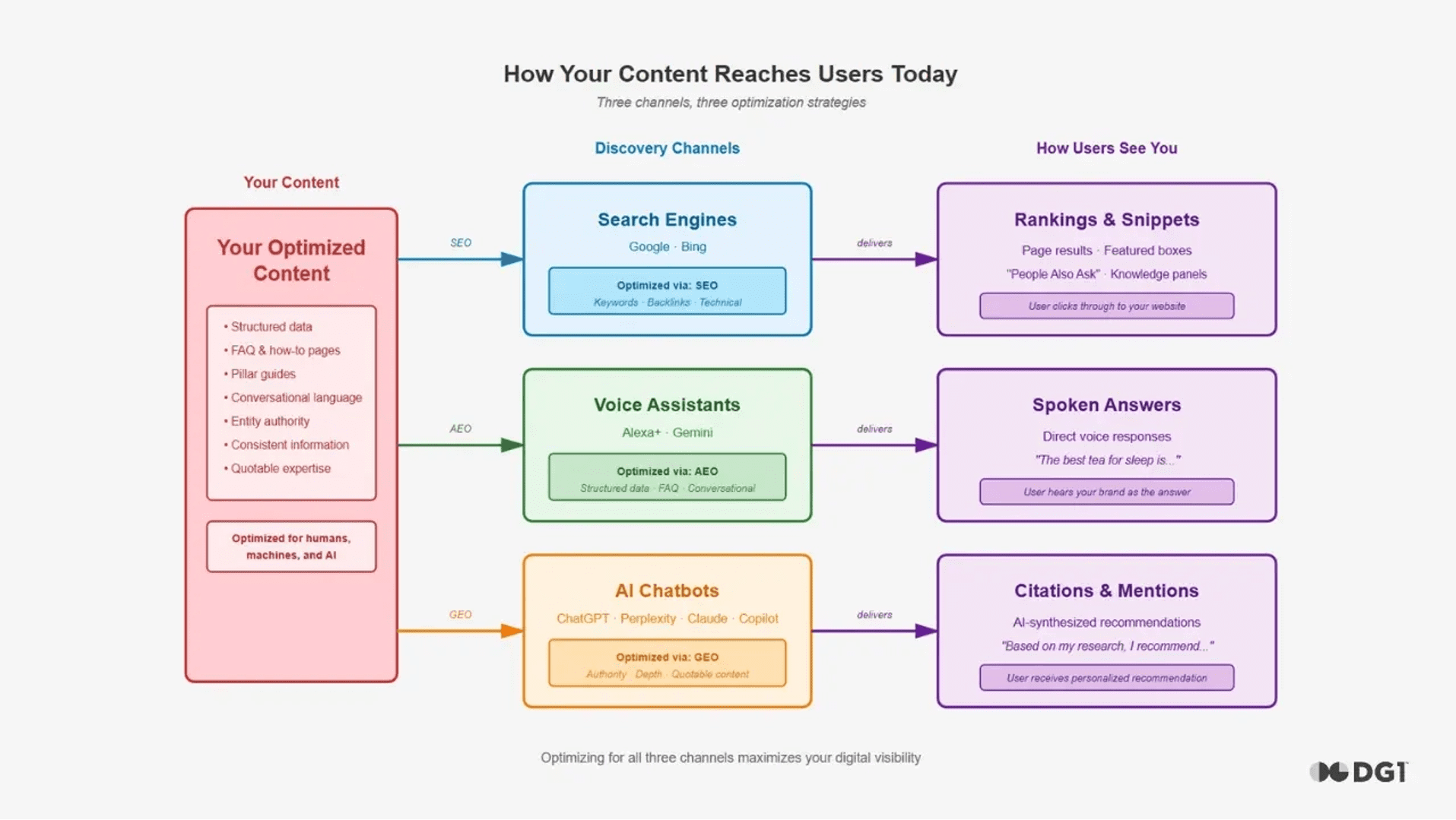
Answer Engine Optimization (AEO) is the practice of structuring your content so AI-powered answer systems (like Google’s AI Overviews, Alexa+, and Gemini) can extract and present it as a direct response to user questions. Instead of hoping users click your link among ten blue results, AEO positions your content as the single answer that appears at the top.
The practical benefits are significant:
Immediate visibility in AI Overviews, featured snippets, and “People Also Ask” boxes
Voice search presence when customers ask conversational questions
Direct answers that establish authority before competitors enter the conversation
Think about the last time you asked your phone a question while cooking or getting ready to go out. You didn’t scroll through results. You got one answer, and you trusted it. That’s exactly what happens when an online tea shop adds a simple FAQ section to their product pages: “What’s the best tea for sleep?” “How long should I steep loose leaf tea?” “Does green tea have less caffeine than coffee?” Each question has a clear, two-sentence answer. When a shopper asks Gemini, “What tea helps you sleep?” that store’s answer shows up as the direct response. No ad spend, no complicated strategy. Just clear answers to the questions customers were already asking.
What is Generative Engine Optimization (GEO)?
Generative Engine Optimization (GEO) takes visibility a step further by optimizing for AI chatbots like ChatGPT, Perplexity, Claude, and Copilot that synthesize answers from multiple sources. These systems don’t just retrieve information: they generate new responses by quoting, paraphrasing, and citing trustworthy sources.
This is already happening in the real world. A jewelry store owner recently asked a new customer how they had found his shop. The answer? “I asked ChatGPT for a recommendation, and it suggested your store.” No Google search, no ad click, no browsing through results pages. The customer went straight from an AI recommendation to walking through the door.
This trend is accelerating across e-commerce. In late 2025, ChatGPT and Perplexity both launched AI-powered shopping features. Now when a shopper asks, “What’s the best waterproof hiking boot under $150?” these AI assistants pull from product data, reviews, and merchant content to recommend specific stores and products. The brands appearing in those recommendations aren’t necessarily the biggest. They’re the ones whose content is structured, comprehensive, and trustworthy enough for AI to cite. That’s what GEO delivers: your products and expertise surfaced at the exact moment a customer is ready to buy.
SEO vs AEO vs GEO: Understanding the Evolution
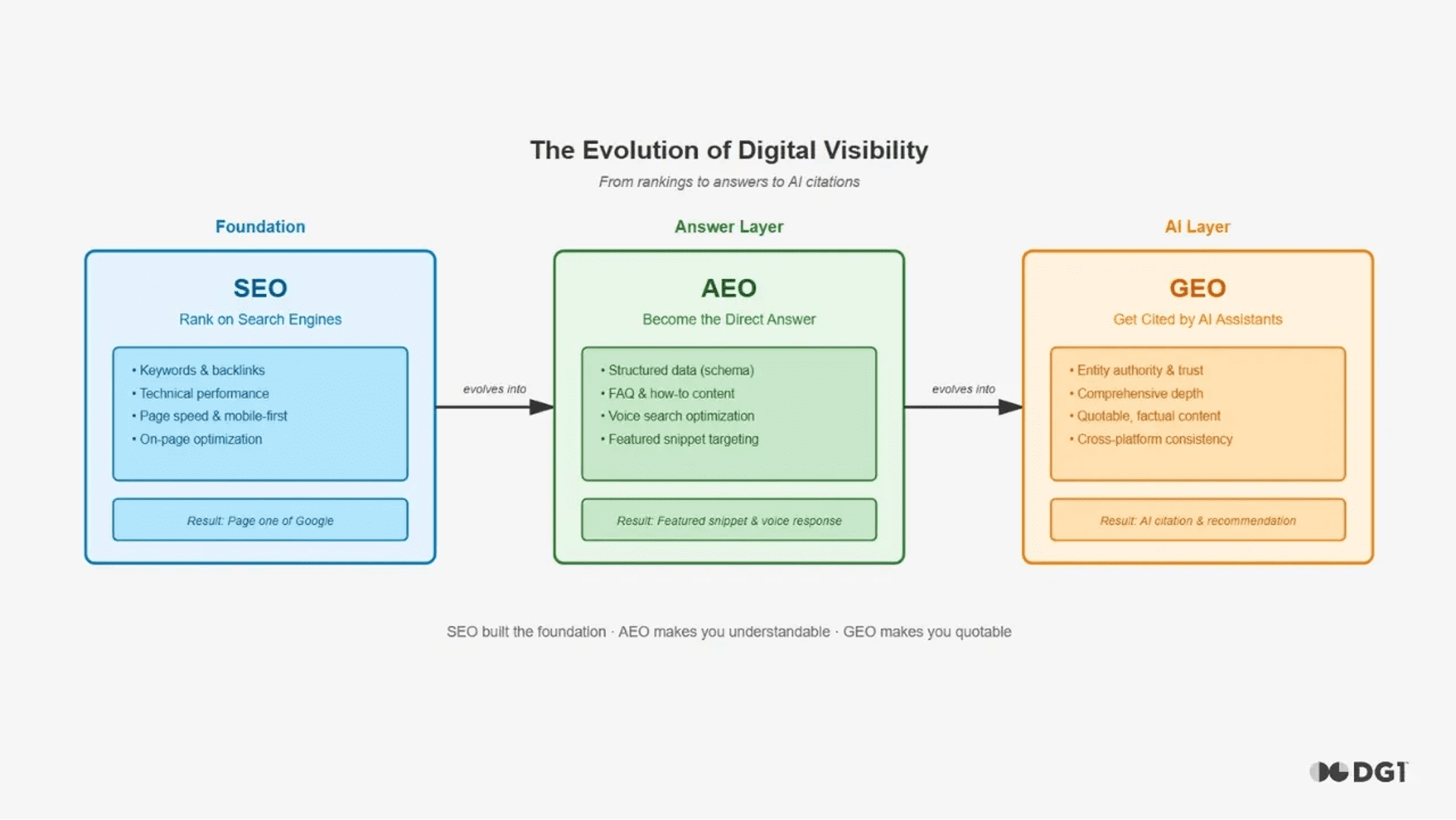
It’s tempting to view these as competing strategies, but they’re better understood as an evolution. SEO built the foundation. AEO makes you understandable. GEO makes you quotable.
Approach |
Primary Goal |
What It Optimizes For |
Example Outcome |
SEO |
Rank higher on search engines |
Keywords, backlinks, technical performance |
Position on page one of Google results |
AEO |
Become the direct answer |
Structured data, clear definitions, FAQ content |
Featured snippet or voice search response |
GEO |
Get cited by AI assistants |
Entity relationships, comprehensive explanations, cited sources |
Mention in ChatGPT or Perplexity response |
SEO isn’t dead. It’s expanding. The businesses thriving today aren’t abandoning traditional optimization; they’re layering AEO and GEO strategies on top of solid SEO foundations. Think of it as speaking multiple languages: you still need to communicate clearly with search engines (SEO), but now you also need to communicate effectively with voice assistants (AEO) and AI synthesis engines (GEO).
Five Steps to Optimize for AI Engines Today
Ready to make your content discoverable by answer and generative engines? Here are actionable steps you can implement immediately.
1. Audit Your Content for Question-Based Queries
Start by uncovering the exact questions your customers are already asking. Google Search Console’s Performance report is your best free resource: filter your queries by question words (who, what, where, when, how, why) to identify high-impression questions where your pages appear but don’t yet rank in the top positions. Tools like AnswerThePublic and AlsoAsked can reveal additional question clusters around your core topics.
Once you’ve identified your target questions, restructure your content to answer them directly. Place a clear, concise answer (40–60 words) in the opening paragraph or immediately after each question heading. This “answer-first” format is exactly what AI systems extract for featured snippets and voice responses. Follow the direct answer with supporting detail, context, and examples.
Example: An online skincare store discovers through Search Console that “how to choose the right moisturizer for dry skin” generates 800 monthly impressions but very few clicks. Google is showing their page, but users aren’t clicking through. They restructure their blog post to lead with a direct, clear answer in the first paragraph rather than burying it below a long product introduction. Within weeks, their content appears as Google’s featured snippet, and as Gemini’s response when shoppers ask the same question.
2. Implement Structured Data Markup
Structured data (schema markup) is a standardized vocabulary that tells AI systems exactly what your content represents. Adding it to your pages is like handing search engines and AI assistants a labeled map of your content instead of making them guess.
Focus on the schema types most relevant to your business:
FAQPage for frequently asked questions
HowTo for step-by-step guides
LocalBusiness for brick-and-mortar locations
Product and Review for e-commerce
Article for blog posts and thought leadership
Validate your implementation using Google’s Rich Results Test and monitor performance through Search Console’s Enhancements report. These tools confirm that search engines can parse your markup correctly and show you which rich results your pages qualify for.
Example: An online makeup lesson provider adds FAQPage schema to their booking page, covering questions like “Do I need my own makeup for the lesson?” and “Can I book a group session?” These answers begin appearing in Google’s “People Also Ask” boxes and voice assistant responses, driving direct bookings without additional ad spend.
3. Create Comprehensive, Authoritative Content
AI assistants cite sources that demonstrate depth and credibility. Thin, surface-level content gets ignored in favor of comprehensive resources that thoroughly address a topic.
Build “pillar content”: in-depth guides of 2,000+ words that cover a subject from multiple angles. Support your claims with specific data points, original analysis, and references to established research. Include perspectives that anticipate follow-up questions, since AI models evaluate whether a source provides a complete picture.
Structure matters just as much as depth. Use clear heading hierarchies (H2, H3), definition-style openings for key concepts, and summary sections that AI can extract as standalone answers. Each section should be able to stand on its own while contributing to a cohesive whole.
Example: Instead of publishing five separate 400-word posts about cooking tips, an online Italian pasta sauce brand with a 100+ year family recipe heritage creates one definitive 3,000-word guide: “The Complete Guide to Authentic Italian Pasta Sauces: Ingredients, Pairings, and Traditions.” The guide covers the differences between marinara, arrabbiata, and other regional sauces, includes pairing suggestions for each pasta shape, and shares the family’s approach to sourcing natural ingredients. Within months, Perplexity and ChatGPT begin citing it when users ask about authentic Italian cooking and sauce recommendations.
4. Optimize for Conversational Language
Voice searches and AI queries are dramatically different from typed keywords. They’re longer, conversational, and almost always phrased as complete questions. Optimizing for this shift means rethinking how you structure your content.
Map out the natural language variations of your target topics. A single product or service page might need to answer:
“What is [product] and how does it work?”
“Is [product] worth it for small businesses?”
“How does [product] compare to [competitor]?”
“What are the pros and cons of [product]?”
Create dedicated sections or FAQ blocks that address each variation. Use the exact phrasing your customers would use in conversation, not the truncated keyword-speak of traditional SEO. Read your content aloud; if it sounds like something a person would actually say, you’re on the right track.
Example: A haircut salon replaces their keyword-optimized page title “men’s fade haircut styles 2026” with a conversational heading: “What Type of Fade Haircut Should I Ask For?” The page content mirrors how a customer would ask their barber in person, and how they’d ask Gemini or ChatGPT. Voice search traffic to the page increases as a result, and the content starts appearing in AI-generated grooming recommendations.
5. Build Entity Authority Through Consistent Information
AI systems don’t just evaluate individual pages. They cross-reference your entire digital presence to assess trustworthiness. “Entity authority” means that AI models recognize your business as a credible, consistent source of expertise on specific topics.
Start with the fundamentals: ensure your business name, description, services, and contact details are identical across your website, Google Business Profile, LinkedIn, industry directories, and social media. Discrepancies (even small ones like “St.” versus “Street”) erode AI confidence in your data.
Then build topical authority by consistently publishing expert content within your niche. AI models track which sources repeatedly provide reliable information on specific subjects. A smart home company that regularly publishes accurate, detailed content about building automation and energy efficiency becomes the entity AI systems associate with that expertise.
Monitor your entity presence by searching your brand name on Google (look for a Knowledge Panel), and periodically test how AI chatbots describe your business by querying them directly. If they don’t mention you yet, that’s your baseline, not your ceiling.
Example: A smart home automation company with over 35 years of engineering experience asks ChatGPT, “What are the best smart home systems for energy efficiency?” and doesn’t appear in the results. They start by standardizing their company description, product specifications, and certifications across their website, LinkedIn, and building technology directories. They publish monthly articles on topics they know firsthand: how automated shading can cut cooling costs by up to 60%, what to look for in a lighting control system, and how smart climate management works in practice. Six months later, they ask the same question again. This time, their brand appears in the AI-generated recommendation alongside major smart home names.
Embracing Long-Term Adaptability
Consider how quickly the landscape has already shifted. Two years ago, most businesses had never heard of GEO. Today, AI-powered shopping is live on ChatGPT and Perplexity, and customers are walking into stores saying, “An AI recommended you.” The pace of change is only accelerating.
The businesses that stay visible will be the ones that keep testing. Run your own product queries on ChatGPT, Perplexity, and Gemini every quarter. Track whether your brand appears, how it’s described, and what competitors show up instead. Treat these checks the same way you’d review your Google rankings: as a regular part of your marketing routine, not a one-time experiment.
Ask your customers how they found you. The answers may surprise you. The patterns you discover will shape your content strategy more effectively than any single tactic.
Your Path Forward Starts Now
The shift from traditional search to AI-powered discovery represents both a challenge and an opportunity. By embracing AEO and GEO alongside SEO, you position your business to:
Become discoverable wherever your customers ask questions, whether that’s Google, Alexa+, ChatGPT, or Gemini
Build authority by being the source AI systems trust and cite
Future-proof your visibility as search technology continues evolving
The good news is that you don’t have to tackle all of this alone. DG1’s platform is built with these modern visibility strategies in mind: from structured data and schema markup to content optimization tools that help your business show up where your customers are actually searching. Whether you’re just starting to explore AEO and GEO or ready to implement a full strategy, the technical foundation is already in place.
Ready to make your content the answer? Book a demo to see how DG1 helps businesses stay visible in the age of AI-powered discovery.